

How to Distinguish Synthetic vs Human Hair: 2026 Guide
Table of Contents
- Why Telling Synthetic vs Human Hair Apart Matters Before You Buy
- Start With a Close Visual Inspection: Shine, Texture, and Cuticle Alignment
- The Burn Test for Hair Extensions: What Ash and Smell Reveal
- The Water and Wash Test: How Fibers Behave When Wet
- Synthetic Hair vs Human Hair Heat Styling: Melting Points and Styling Limits
- Human Hair vs Synthetic Hair Lifespan: Longevity, Shedding, and Cost Per Wear
- Blended Hair, Ethical Sourcing, and Where to Shop With Confidence
- Conclusion: Test Before You Trust the Label
- Frequently Asked Questions
Last Updated: October 4, 2026
Why Telling Synthetic vs Human Hair Apart Matters Before You Buy
Learning how to distinguish synthetic vs human hair takes about ten minutes and saves you real money. The stakes are simple: synthetic polymer fiber and protein fiber behave nothing alike under heat, water, or time.
We stock both types and we hear the same complaint constantly: "I cannot tell what I actually bought." Labels lie, packaging is vague, and blended hair sits in the middle to confuse things further. Below, we walk through six tests you can run at home or at your station, starting with the one you can do in a store before you spend a cent.
Start With a Close Visual Inspection: Shine, Texture, and Cuticle Alignment
Visual inspection is the fastest first filter. Hold the bundle near a window and look at how light hits it. Human hair has a natural luster that shifts as you rotate the strand. Synthetic fiber reflects light flatly and evenly, which is what people mean when they describe unnatural shine.
Run your thumb down a single strand from root to tip. Real hair feels slightly rough in one direction because the cuticle scales lie in alignment. Synthetic fiber, usually monofilament, feels uniformly smooth in both directions.
- Luster: human hair looks duller in shade, brighter in direct light; synthetic stays glossy everywhere
- Cuticle alignment: real strands catch slightly when rubbed backward; synthetic glides
- Static electricity: synthetic fiber crackles and clings to itself in dry air
Luster and Unnatural Shine
A matte finish is a strong signal of human hair. If the bundle glows under overhead lighting like a new ribbon, you are almost certainly holding synthetic polymer. Some human hair is coated to boost shine, so treat this as a clue, not proof.
Density, Denier, and Weft Construction
Turn the weft over and inspect the stitching. Human hair wefts are often hand-tied and slightly uneven. Synthetic wefts are machine-sewn with tight, uniform rows. Look at the denier, the thickness of each individual strand: synthetic fiber is manufactured to a consistent denier, so every strand matches. Human hair varies from strand to strand because no two follicles produce identical fiber.
The Burn Test for Hair Extensions: What Ash and Smell Reveal
The burn test for hair extensions is the closest thing to a definitive answer. Snip a small strand, hold it with tweezers over a heat-safe surface, and bring a lighter to the tip.
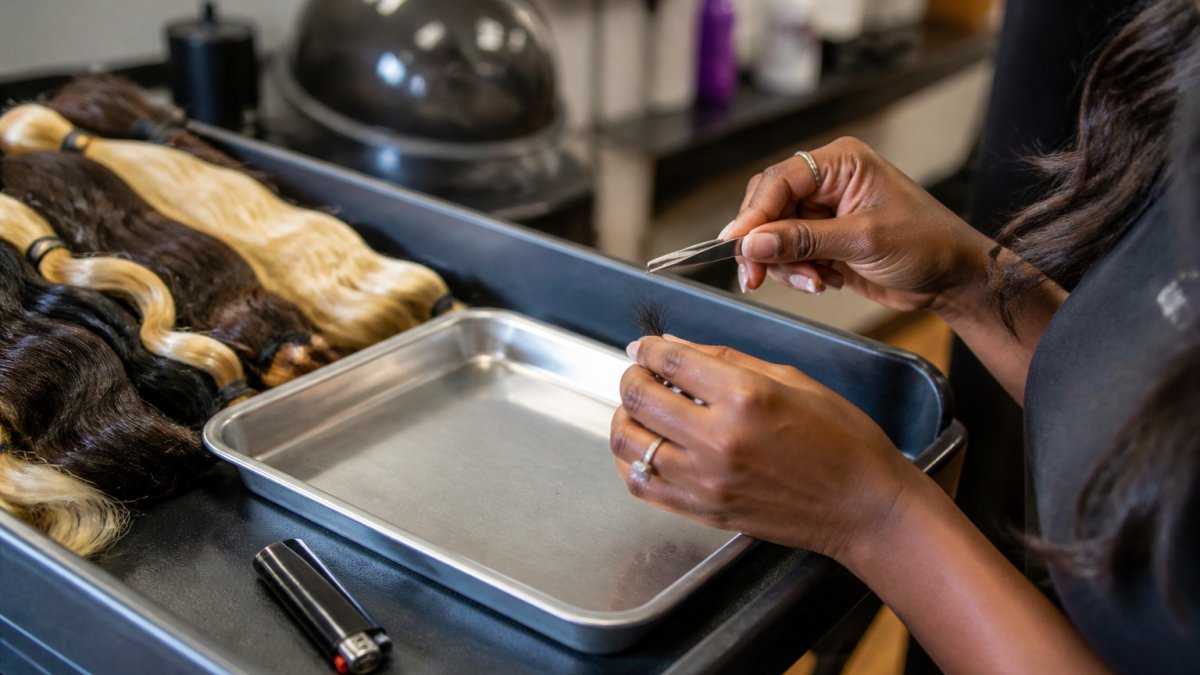
Human hair is protein fiber. It smells like burning hair, which most people recognize immediately, and it leaves a crumbly black ash that breaks apart between your fingers. Synthetic fiber is a plastic.
The Water and Wash Test: How Fibers Behave When Wet
Water behavior separates the two fibers, but only if you actually time it. Fill a clear glass with room-temperature water (about 68 to 75 degrees Fahrenheit) and drop in one clean strand about four to six inches long. Start a timer and watch.
Human hair is hygroscopic: its cuticle lifts slightly and the cortex absorbs water, so the strand swells in diameter and gains weight. Most human strands begin to sink within 30 to 90 seconds and settle on the bottom within a few minutes. Synthetic polymer fiber is hydrophobic.
What the Wash Step Reveals
Water alone is a clue; shampoo and drying turn it into a test. Work a dime-sized amount of mild sulfate-free shampoo into the wet strand, rinse under lukewarm water, and lay it flat on a paper towel to air dry at room temperature. Note three things:
- Drying time: human hair holds moisture and can take 45 to 90 minutes to fully air dry at room temperature; synthetic fiber sheds surface water fast and is often dry in 15 to 30 minutes.
- Shape after drying: human hair dries with soft texture, a slight bend, or a loose wave from how it was resting. Synthetic fiber dries back into the exact factory curl or straightness it was manufactured with, this is shape memory, and it is the single most reliable water-test giveaway.
- Wet feel: wet human hair feels heavier and slightly tacky as the cuticle opens. Wet synthetic feels slick and lightweight, almost like wet nylon cord.
Why Blends Fool the Water Test
A blended weft can pass the float test because the human strands add weight and the synthetic strands add buoyancy, so the bundle sinks at a middling rate that looks like real hair. This is exactly why the water test narrows the odds but does not close the case. Treat a middling result as a prompt to run the burn test on a strand pulled from the middle of the weft, not the end.
Synthetic Hair vs Human Hair Heat Styling: Melting Points and Styling Limits
Heat is where the two fibers part ways completely, and the reason is chemistry. Human hair is a protein fiber built from keratin held together by hydrogen, salt, and disulfide bonds. Those bonds break and reform with heat and moisture, which is why real hair can be curled, straightened, and re-curled.
Standard synthetic fiber, usually modacrylic, polyester, or PVC-based monofilament, is a thermoplastic. It does not have bonds to reform; it has a glass-transition temperature and a melting point.
Heat-Friendly and Heat-Defiant Fiber
Some synthetic fiber is engineered to tolerate higher heat and is sold as heat friendly or heat defiant. Even these fibers usually top out around 350 to 400 degrees Fahrenheit, and the safe rule is to keep the iron moving, use the lowest effective setting, and test on a hidden strand first. If the strand smells acrid or the tip glazes, stop, that fiber will not survive repeated thermal styling.
A Non-Destructive Chemical Spot Test
Before you ever touch a hot tool to an unknown strand, you can run a safe chemical spot test using items already in most kitchens. These are not definitive like the burn test, but they are non-destructive and can be run on a strand you intend to keep.
- Rubbing alcohol (isopropyl): soak a strand for one minute. Human hair is largely unaffected. Some synthetic coatings and low-grade fibers soften, dull, or shed a slight residue into the alcohol.
- Acetone (nail polish remover): dab a small amount on the tip of a strand in a ventilated area. Many synthetic fibers soften or partially dissolve; human hair does not. Acetone is harsh, test on a single strand, never a full weft, and keep it off skin and finished surfaces.
- Hot water immersion: drop a strand into water heated to about 180 degrees Fahrenheit for 30 seconds. Human hair relaxes and may take a slight set. Standard synthetic fiber can visibly shrink, crimp, or snap back harder into its factory shape.
Fiber Memory and Why It Matters for Styling
Fiber memory is the tendency of a strand to return to its original shape. Synthetic fiber has strong memory: wet it, heat it, sleep on it, and it springs back to the factory curl. Human hair has weak memory and takes on new shapes over time, which is why a human bundle can be re-curled, straightened, and re-styled for months. If a strand refuses to hold a new shape no matter how you set it, that is fiber memory pointing to synthetic.
Human Hair vs Synthetic Hair Lifespan: Longevity, Shedding, and Cost Per Wear
Human hair vs synthetic hair lifespan is the comparison that decides value. Human hair, when cared for properly, can last a year or more with re-styling between wears. Synthetic fiber typically holds up for a limited number of wears before the ends frizz, tangle, and shed.
- Shedding: human hair sheds lightly at the weft; synthetic sheds more as fiber breaks down
- Tangle resistance: real hair detangles with conditioner; synthetic tangles once the coating wears off
- Color retention: human hair can be recolored; synthetic is set at the factory and cannot be lightened
- Cost per wear: the higher upfront price of human hair often works out cheaper over a year of regular use
Blended hair, which mixes human and synthetic fiber in one weft, is the hardest to judge. It passes some tests and fails others, which is exactly why sellers use it. Ask for the fiber content in writing before you buy.
Blended Hair, Ethical Sourcing, and Where to Shop With Confidence
Blended hair is the fastest-growing source of confusion in the extension market. A weft can pass the water test, feel soft, and still be half synthetic. The only reliable check is the burn test on a strand from the middle of the weft, not the end, since some sellers finish the ends with real hair.
Ethical sourcing is the other question worth asking. Reputable suppliers can tell you where the hair was collected and how it was processed. If a seller cannot answer basic questions about origin and chemical treatment, treat that as your answer.
At Get Sassy Beauty Supply, we carry both human and synthetic options and label them clearly, so you know exactly what you are buying before it ships. Our catalog includes braiding hair, wigs, and extensions across a range of textures.
Conclusion: Test Before You Trust the Label
The gap between what a label claims and what is actually in the bundle is the single biggest risk in buying extensions. Learn the six tests, keep a lighter and a glass of water handy, and you will never overpay for plastic again.
Get Sassy Beauty Supply stocks clearly labeled human and synthetic hair, plus the barber tools and salon equipment to style both. Shop All.
Frequently Asked Questions
How can you tell if hair is 100% human hair?
Run two quick checks. First, the burn test: a single strand of human hair smells like burnt hair and turns to gray ash that crumbles, while synthetic melts into a hard bead and smells like burning plastic. Second, the wash test: human hair gets heavier and holds water, while synthetic repels it and dries fast. Also check the weft for a matte finish and cuticle alignment rather than uniform plastic shine.
Does synthetic hair melt when you use a flat iron?
Most synthetic fibers melt or fuse at temperatures well below what human hair handles, so a standard flat iron set for human hair will damage them. Heat-friendly synthetic options tolerate low heat, but you must keep the iron under roughly 300°F and test a hidden strand first. Human hair can be flat-ironed, curled, and blow-dried at normal salon temperatures without melting, which is why it costs more.
How long does human hair last compared to synthetic hair?
With proper care, human hair extensions often last six months to a year or more because the fiber tolerates washing, thermal styling, and color services. Synthetic hair typically lasts a few weeks to a few months before tangling and shedding, since heat and friction break down the fiber. Human hair costs more upfront, but the cost per wear can be lower if you reuse it.
Can you dye synthetic hair like human hair?
No. Synthetic hair is a polymer fiber, so dye and bleach do not absorb the way they do in human hair; color sits on the surface or causes melting. Human hair, especially virgin or unprocessed hair, accepts dye, toner, and bleach like your own hair. If you need a custom color, buy human hair or a pre-colored synthetic shade instead of trying to dye it at home.